
At Betfred Poker we offer two Poker variants namely No Limit Texas Hold’em and Pot Limit Omaha.
Whilst there are some slight differences between them, they have identical betting structures with four rounds of betting known as pre-flop, the flop, the turn and the river.
What are the differences between No Limit Texas Hold’em and Pot Limit Omaha?
In No Limit Texas Hold’em each player is dealt two cards (known as hole cards or pocket cards) and must make a hand comprising any five cards out of the seven cards available (two hole cards and five community cards – more on this later). Additionally, in any given betting round, players can bet as much as they want from the chips they have on the table.
In Pot Limit Omaha each player is dealt four hole cards and must make a hand comprising five cards out of the nine cards available using exactly two cards from their hole cards and three cards from the community cards. Additionally, in any given betting round, the most that players can bet is capped at the amount in the pot prior to them betting.
Passage of Play
Before any cards are dealt, the two players directly to the left of the dealer button must place bets called ‘blinds’. These bets are forced bets and are there to stimulate action on every hand. The player to the immediate left of the dealer button places the small blind, equal to half of the minimum stake, and the player to the left of the small blind places the big blind, equal to the minimum stake.
Once the blinds have been placed, each player is dealt their hole cards face down with the first card being dealt to the small blind, the second to the big blind and so on around the table in a clockwise direction. Each player is dealt one card at a time until all players have their allotted hole cards. Remember, in Texas Hold’em each player gets two hole cards and in Omaha, each player gets four hole cards.
When all hole cards have been dealt, the betting begins with the player to the immediate left of the big blind being the first to act in the pre-flop betting round and the action moving clockwise around the table.
In each betting round players must choose an action from the following options;
- Check – To check is to not bet. Players can only check when no other bets have been made in a betting round.
- Bet – To bet is to open the betting (be the first to bet) in any given betting round.
- Call – To call is to match the highest bet in order to remain in the game.
- Fold – To fold is to take no further action in the current hand and to forfeit any claim on the money in the pot.
- Raise – To raise is to match the highest bet and then make a greater one. Where a raise is followed by another raise, it is called a re-raise.
Once all players have taken an action and any remaining players in the hand have all bet an equal amount, the pre-flop betting round is over and the first three community cards are dealt.
The first three community cards (also known as the ‘flop’) are dealt face up in the centre of the table for all players to see. Betting on the flop then begins with the player closest to the left of the dealer button and continues as per the previous round until any remaining players have again each bet an equal amount.
The fourth community card (also known as the ‘turn card’) is also dealt face up in the centre of the table and betting on the turn then begins and plays out in precisely the same manner as the betting on the flop, finishing when any remaining players have each bet an equal amount.
The fifth community card (also known as the ‘river card’) is the last community card and is also dealt face up in the centre of the table, at which point the final betting round commences and again plays out in the same manner as the previous betting rounds, finishing when any remaining players have each bet an equal amount.
When the final betting round is complete, any remaining players reveal their hole cards and the player with the highest ranked hand (see below for hand rankings) wins the pot. This is called the ‘showdown’. If two or more players have an equally ranked hand, the pot is split equally between them.
All-in
When a player runs out of chips during the course of a hand, they do not have to fold. Instead they will be deemed to have gone "all-in". When you are all-in, you ‘call’ with all your remaining chips and the pot is divided into the main pot and side pot. All chips subsequently bet by other players remaining in the hand are thereafter added to the side pot, and cannot be won by the all-in player.
At the showdown, if the all-in player does not have a winning hand, both the side pot and the main pot go to the player with the winning hand. If however the all-in player has a winning hand, the main pot goes to the all-in player, and the side pot goes to the player with the next best hand.
When several players go all-in, multiple side pots are created. The pots are divided according to hand and order in which the players went all-in. If a player not all-in at the showdown has the winning hand, they wins all side pots and the main pot. If an all-in player has the best hand they win the pot or pots that were collected until they went all-in. Any all-in player with a winning hand can only win the pot or pots they are involved in.
Poker Hand Rankings
The winning hand in both Texas Hold’em and Omaha is determined by the order of hand rankings detailed below. The hands listed here are shown from strongest to weakest. An Ace can be used as both a low card and a high card when forming a straight or a straight flush but in the instance an Ace forms part of a low straight (A-2-3-4-5), it does not count as the highest card in the hand.
Each ranked hand is illustrated by an example where the following abbreviations are used: c - Clubs, d - Diamonds, h - Hearts, s - Spades; J - Jack, Q - Queen, K - King, A - Ace.
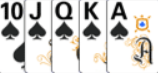 |
Royal Flush Five cards in sequence from 10 to Ace and of the same suit Example: 10s, Js, Qs, Ks, As |
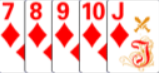 |
Straight Flush Any other five cards in sequence and of the same suit Example: 7d, 8d, 9d, 10d, Jd |
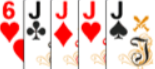 |
Four of a Kind Four cards of the same value and any other card Example: Jc, Jd, Jh, Js, 6h |
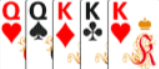 |
Full House Three cards of one value together with two cards of another value. When one Full House is competing against another, the one with the highest ranking group of three wins. Example: Qh, Qs, Kd, Kc, Kh |
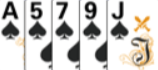 |
Flush Five cards of the same suit but not in sequence. When one flush is competing against another, the one with the highest card wins. Example: As, 5s, 7s, 9s, Js |
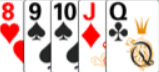 |
Straight Five cards in sequence but not of the same suit. When one straight is competing against another, the one with the highest card wins. Example: 8h, 9s, 10s, Jd, Qc |
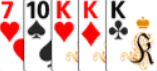 |
Three of a Kind Three cards of the same value and any two others. Example: Kh, Kd, Kc, 10s, 7h |
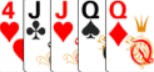 |
Two Pair Any two cards of one value together with two cards of another value and any other card. When more than one hand has two pairs both of the same value, the hand with the highest card outside the paired cards wins. Example: Jc, Jh, Qs, Qd, 4h |
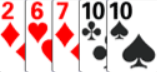 |
One Pair Two cards of the same value. Where two hands have pairs, the highest pair wins. When more than one hand has a pair of the same value, the hand with the highest card outside the pair wins. Example: 10c, 10s, 7d, 6h, 2d |
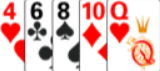 |
Highest Card Five unmatched, unsuited and non-sequential cards. When players have none of the above, the hand with the highest card wins. Example: Qh, 10d, 8s, 6c, 4h |